EU CBRN CoE Newsletter vol. 19: updates and highlights from the Initiative’s eight regions

The EU CBRN Centres of Excellence published its latest Newsletter, sharing the main updates and highlights from the Initiative’s eight regions. The advancement of regional and interregional cooperation in CBRN risk mitigation throughout the CoE network stands out as the underlying theme in this new release. As the issue shows, CoE Partner Countries are increasingly engaging in regional and inter-regional activities to tackle together CBRN risks, which know no borders.

Read more HERE

Projekt R-PLAN

Projekt R-PLAN (Networking for Cross-border Risk Management Plan) – Sieťovanie pre plánovanie cezhraničného riadenia rizík, je financovaný z UCPM (Union Civil Protection Mechanism –Mechanizmus civilnej ochrany EÚ), dĺžka jeho implementácie je obdobie 2 rokov (december 2020 – november 2022). Hlavným cieľom projektu je posudzovanie rizík územia v kontexte civilnej ochrany obyvateľstva a sieťovanie aktérov civilnej ochrany a krízového riadenia pre aplikáciu súvisiacich riešení do praxe.

Hlavnými výstupmi projektu sú: (1) Metodika pre posúdenie rizík SR v kontexte civilnej ochrany obyvateľstva, ktorá je harmonizovaná s podobným dokumentom v ČR. Tento prístup umožňuje vzájomne porovnávať zistenia na národnej úrovni, a to s cieľom zjednodušenia spoločného plánovania pre zvyšovanie odolnosti voči hrozbám. Pre podporu spolupráce na nižšej – regionálnej úrovni je metodika spracovaná aj pre potreby menšieho územia – kraj (v budúcnosti je možné regionálnu metodiku  pripraviť aj na úrovni okresov, resp. obcí).

Ďalším dôležitým dokumentom, o ktorý sa metodika opiera, je aktualizovaný (2) Register hrozieb SR (aktualizovaná verzia pre rok 2022). Obsahuje rozdelenie hrozieb podľa ich hlavných gestorov.

Pre potreby aplikácie metodiky do praxe je pripravený (3) Vzdelávací materiál vo forme prezentácií a jednoduchých príkladov na pochopenie problematiky. 

Diseminačné aktivity v rámci projektu boli realizované na základe komunikačného plánu, poslednými aktivitami bola Záverečná konferencia organizovaná ISEM Inštitútom v dňoch 20. – 21. 9. 2022 v priestoroch Žilinskej univerzity v Žiline a pracovné stretnutie v Ostrave na akademickej pôde VŠB – Technickej univerzity v Ostrave v dňoch 7. – 8. 11. 2022. Oboch stretnutí sa zúčastnili projektový koordinátor – ISEM Inštitút, partner z ČR – Institut ochrany obyvatelstva a experti.

A Prosecutor’s Guide to Chemical and Biological Crimes – May 2022

The purpose of the Guidebook is to provide police and civil prosecutors, and relevant investigative agencies, with guidance to support the successful prosecution of incidents involving the deliberate use of a chemical or biological agents. The Guidebook aims to provide awareness and insight into the current and emerging challenges related to the investigation and prosecution of such crimes.

You can find the guidebook on this link

Safe stadium in Phnom Penh in Cambodia

Cambodia is going to host ASEAN Games in 2023 and CBRN protection of this sport event is one of the tasks for succesfull organization. New modern sport complex  „Morodok Techo National Stadium“ with main stadium, aquatic centre, indoor sport facilities and training halls will be ready for all competitions.

International Security and Emergency Management Institute (ISEMI) as part of the consortium of Safe stadium project in cooperation with Cambodian General Secretariat of National Authority for Prohibition of CBRN Weapons (NACW) conducted working meeting in Phnom Penh in Cambodia on 3rd and 4th of May 2022. Main aims of the meeting were to visit National stadium in Phnom Penh, to present project Safe stadium and to share current outcomes implemented in EU from this project. In addition, ISEMI representative provided initial advice how to organize CBRN Protection during ASEAN Games 2023. NACW authorities are very interested in Safe stadium project and they will appreciate if all significant deliverables from Safe stadium project can be shared or delivered as new project in Cambodia with the aim to improve CBRN protection of sport/mass events in Cambodia.

The study of crime begins with the knowledge of oneself

What does CBRN stand for? Normally, there is a simple answer that relates to hazardous substances. Ultimately, this abbreviation encompasses a much broader context than chemical, biological, radiological and nuclear materials with certain chemical, biological, and physical properties…

Another article from the pen of dr. Marián Kolenčík, published by scientific council of CBRN World journal. You can read the whole article on the link below.

ARTICLE LINK


CBRN-E crime and offenders‘ motives. What is it? Why people do it?

Topics related to chemical, biological, radiological, nuclear and explosive materials are increasingly being discussed in today´s society. Their connection with crime leads us to another dimension, which necessarily requires deeper investigation. This significantly affects several types of crime, including environmental crime, because they are closely related to each other. From practice, we feel that there is no comprehensive (and) global view of law enforcement activities in the existing complex CBRN-E crime. We also perceive the shortcomings in the standard operational procedures of security forces for CBRN-E incidents, which must be regularly updated in connection with emerging technologies. These shortcomings often stem from the different terminology from which many activities are derived. This applies in particular to CBRN police units, teams such as SWAT, EOD, K9, special operation teams (undercover), security and protection forces, CSI-forensics, public order police, environmental police, and anti-narcotics force, etc. Literature writes mostly about CBRN-E terrorism, and only a minimal amount of information on wide range of CBRN-E crimes is mentioned. Therefore, linking this topic only to terrorism is not relevant today. It is necessary to perceive this phenomenon in a broader context. The aim of this article is to present the results of our comparative study related to the definitions of CBRN-E and HazMat materials, threats, and incidents. In the article, we also propose our own definition and categorization of CBRN-E crime, including related concepts based on our examination of real cases around the world, a study of the literature, legislation and history. Another aim of this paper is to create a basis for in-depth qualitative and quantitative research by the ISEM Institute related to the prevalence of CBRN-E crime in selected countries, as well as a framework for a deep case comparative study. In the final part of the article, we will focus on the motivation, motive and intents in committing CBRN-E crime using specific analysed cases, which may be used in the future in the investigation of similar cases and case linkage.

FULL ARTICLE HERE

Crime scene investigation in a CBRN context

CBRN-E crimes are closely linked to environmental crime and their number is constantly growing. Their investigation is a major challenge, and many countries urgently need to improve their systems. An important role for law enforcement agencies is to identify, secure and provide relevant evidence in court proceedings to ensure that the perpetrators are brought to justice. On-site investigation in the CBRN context must therefore meet high quality standards to maintain the safety of investigators and preserve the evidence, which requires skilled and educated experts. This preprint paper describes the basic attributes of a crime scene investigation under CBRN conditions and recommends a global framework of procedures for investigators. It represents a basis for future Biological and Chemical Crime Scene Management Guidance Manual for Law Enforcement planned to be developed by international team of experts under the Umbrella of UNICRI.

FULL ARTICLE LINK HERE 

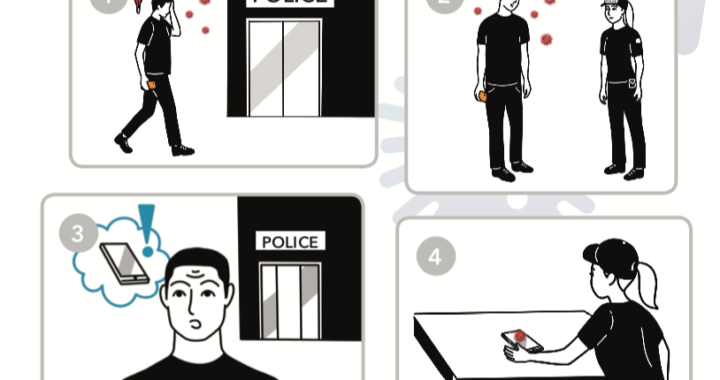
Leaflets for Law Enforcement Agencies – How to act in the COVID-19 environment during a police duty

These guidelines also include information leaflets in a separate ZIP attachment. Full text guidelines provide basic facts about COVID-19 and suggests adequate procedures related to protection of police officers from SARS-Cov2 virus infection and contamination while performing their regular duty, intervention and police operation. Low enforcement officers within different units may get familiar with various risky COVID-19 zones, preparedness for a risky duty and the selection of appropriate personal protective equipment (PPE). The guidelines recommend the propre dressing and use of PPE during police duty, decontamination and disinfection procedures, undressing as well as bio-waste management. This Guidance can be freely distributed only to law enforcement agencies upon the request sent to [email protected]. Each police agency can use this framework of guidelines and adapt it to its national or regional situation and legislation.

FULL ARTICLE LINK HERE

GUIDANCE FOR POLICE AND GENDARMERIE OFFICERS – HOW TO PROTECT YOURSELF IN CORONAVIRUS RISKY ENVIRONMENTS

These guidelines provide basic facts about COVID-19 and suggests adequate procedures related to protection of police officers from SARS-Cov2 virus infection and contamination while performing their regular duty, intervention and police operation. Low enforcement officers within different units may get familiar with various risky COVID-19 zones, preparedness for a risky duty and the selection of appropriate personal protective equipment (PPE). The guidelines recommend the propre dressing and use of PPE during police duty, decontamination and disinfection procedures, undressing as well as bio-waste management. This Guidance can be freely distributed only to law enforcement agencies. Each police agency can use this framework of guidelines and adapt it to its national or regional situation and legislation.Guidelines also include information leaflets in a separate ZIP attachment.

FULL ARTICLE LINK HERE